
Briksdal Glacier Melting: Then & Now, and What You See Today
This guide contains affiliate links. If you book through them we may earn a commission at no extra cost to you. Learn more
Yes, Briksdal glacier is melting. After advancing across its lake in the 1990s, Briksdalsbreen retreated rapidly after 2000, and by autumn 2007 its front no longer reached the water. Today visitors look across the glacier lake, Briksdalsbrevatnet, at an ice front that sits on the slope above the far shore. The retreat fits a wider pattern: in 2024, 34 of 35 glacier outlets measured by Norway’s water and energy directorate (NVE) got shorter.
This page explains how the glacier has changed since measurements began in 1900, why it advanced and retreated, and what to look for when you visit.
Briksdalsbreen in numbers
| Fact | Value | Source |
|---|---|---|
| Highest point | About 1,910 m | Briksdalsbre Fjellstove |
| Lowest point | About 346–350 m, at the lake | Lodge / Wikipedia |
| Area | About 10.4 km² | Lodge |
| Share of area above 1,500 m | About 88% | Lodge |
| Age of the glacier | Formed about 2,500 years ago | Lodge |
| Parent glacier | Jostedalsbreen, about 800 km² and shrinking | Store norske leksikon |
Briksdalsbreen is a western outlet arm of Jostedalsbreen, the largest glacier on the European mainland, and lies inside Jostedalsbreen National Park, created in 1991. Most of its area sits on the high plateau. From there the ice tumbles from about 1,500 m down to about 350 m over a horizontal distance of only 2 km. That steep icefall is why the glacier reacts relatively quickly to changes in snowfall and temperature.

Timeline: more than a century of measurements
The position of the glacier front has been measured since 1900, when Johan Rekstad of Bergen Museum began the series, according to the lodge’s history page. The key phases:
| Period | What happened |
|---|---|
| 1900–1934 | Small variations, with minor advances around 1910 and 1929 |
| 1934–1951 | Retreat of more than 800 m; the lake Briksdalsbrevatnet was exposed |
| 1967–1997 | Advance of about 465 m; the ice covered the whole lake and reached its outlet |
| Early 2000s | Rapid retreat; by 2004 the front was about 230 m behind the lake outlet |
| Autumn 2007 | The front was no longer in the lake |
| 2008–2010 | Small changes: 12 m of retreat in 2008, an 8 m advance in 2010 |
Figures for 1934–2010 are summarised by the lodge and by Wikipedia from the long-term measurement record. NVE publishes the annual front-variation results for Norwegian glaciers in its yearly report series, Glaciological investigations in Norway.
Why did Briksdal advance in the 1990s?
Briksdalsbreen is a maritime glacier. It lives on heavy winter snowfall from Atlantic weather systems as much as on cool summers. Researchers have linked the late-20th-century advance of the western Jostedalsbreen outlets to a run of very snowy winters in the late 1980s and 1990s. More snow on the plateau pushed extra ice down the steep icefall, and a few years later the front advanced into the lake.
That is why old photographs and postcards from the 1990s show ice reaching right down to the water, The contrast with today is striking.
Why has it retreated since 2000?
Since the early 2000s, warmer summers and less favourable winters have meant the glacier loses more ice than it gains. The steep, fast-reacting tongue responded within a few years. A study in the Journal of Glaciology has modelled how the front of Briksdalsbreen may respond to future climate scenarios, using it as a case study precisely because it reacts so quickly.
The trend is not unique to Briksdal. In 2024, NVE measured the fronts of 35 glacier outlets across Norway and 34 of them had become shorter. Jostedalsbreen itself is described by the Norwegian encyclopaedia as about 800 km² “but decreasing”.
What you see at Briksdal today
When you reach the end of the walk from the lodge, you stand on the shore of Briksdalsbrevatnet. Look for:
- The ice front on the slope across the lake, with crevasses and blue ice where the surface is fresh.
- Bare, polished rock between the ice and the water: ground that was under the glacier in the 1990s.
- Milky green water, coloured by fine rock flour ground up by the moving ice.
- Moraine ridges and boulders along the lake, left behind by earlier ice positions.
- The river and Kleivafossen on the way back, carrying the glacier’s meltwater down the valley.
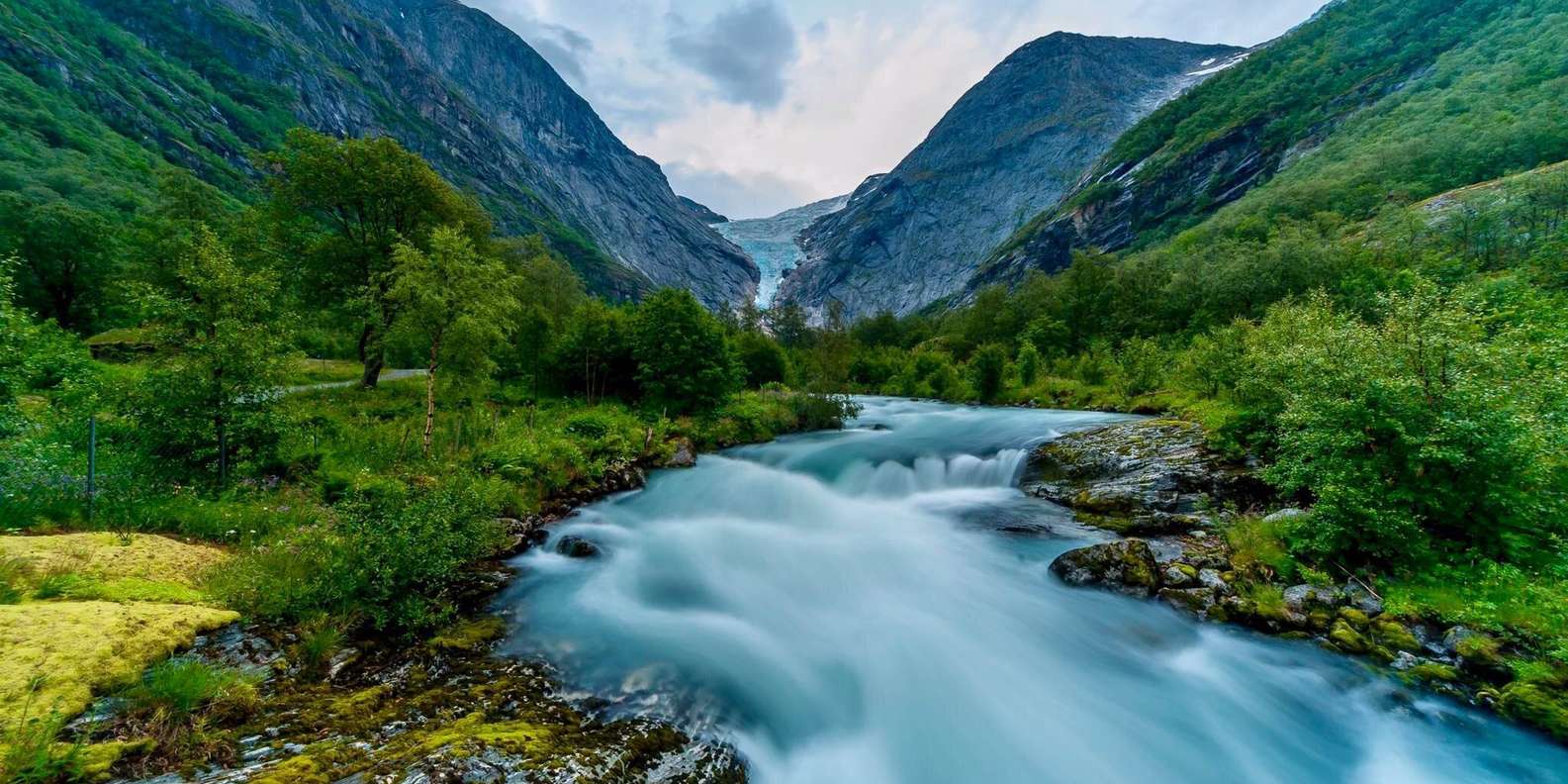
You stand on bare, scoured rock that was buried under ice within living memory. Across the green water the glacier front is close enough to show its cracks and its deep blue seams, yet clearly set back from the shore. Somewhere below the ice, meltwater streams hiss towards the lake.
Keep in mind that the ice is still active. The regional tourist board warns that it is highly dangerous to go close to the glacier because it moves and avalanches can occur. Stay behind the barriers, even where the ice now looks far away.
Is Briksdal still worth visiting?
Yes. The glacier is smaller than in the 1990s, but the setting remains dramatic: an icefall spilling off a 1,900 m plateau, a waterfall you walk beneath, and a lake framed by steep valley walls. Seeing the retreat in person is also one of the clearest ways to understand how Norway’s glaciers are changing. For a balanced view, read our Briksdalsbreen FAQ, which covers whether the trip is worth it for different travellers.
Seeing more of Jostedalsbreen
Several other arms of Jostedalsbreen are easy to reach from Olden and Loen. Kjenndalsbreen lies about 17 km from Loen at the end of the Lodalen valley (toll road), a 15-minute walk from the car park. The Jostedalsbreen National Park Centre in Oppstryn, near Stryn, explains how glaciers form and change. Our guide to things to do near Briksdalsbreen lists more.
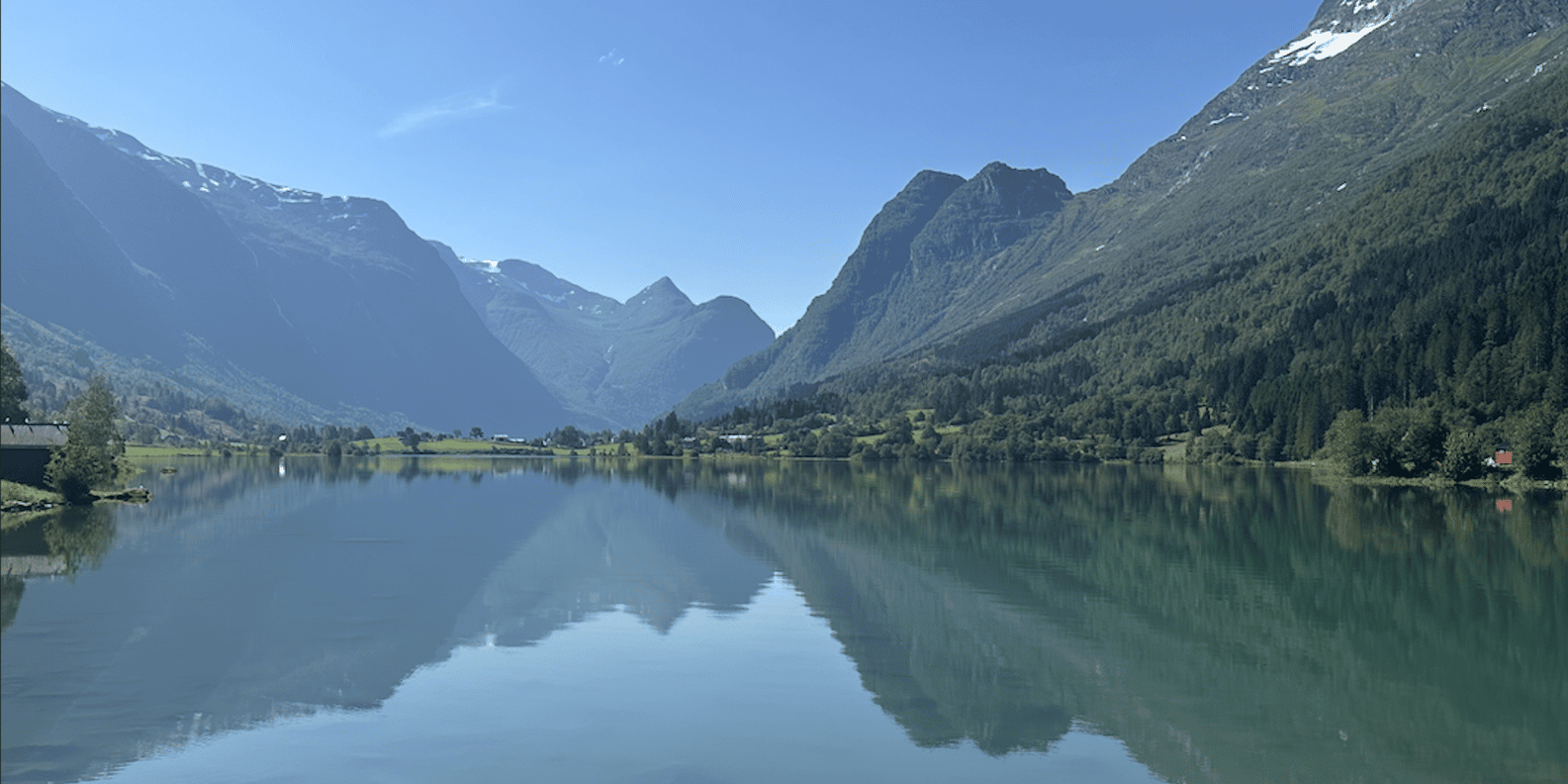
If you want a guide to explain the landscape on the spot, the 4-hour guided hiking excursion from Olden includes a guided walk to the viewpoint. Compare it with other options in our Briksdal tours guide.
See the guided Briksdal glacier walk →
Frequently asked questions
Is Briksdal glacier melting?
Yes. After a strong advance in the 1990s, the front retreated quickly after 2000 and left the lake by 2007. Small year-to-year changes still occur, but the long-term trend is retreat.
How much has Briksdal glacier retreated?
Between 1934 and 1951 it retreated more than 800 m. It then advanced about 465 m between 1967 and 1997, before retreating again so that by 2004 the front was about 230 m behind the lake outlet.
Why did Briksdal glacier grow in the 1990s?
Researchers link the advance to a series of very snowy winters on the Jostedalsbreen plateau in the late 1980s and 1990s. Extra snow fed the steep icefall and pushed the front into the lake.
Can you still see the ice at Briksdal?
Yes. The ice front is clearly visible from the viewpoint at the glacier lake, about 2.5–3 km on foot from the lodge.
Is Briksdalsbreen part of Jostedalsbreen?
Yes. It is a western outlet arm of Jostedalsbreen, the largest glacier on the European mainland, and lies inside Jostedalsbreen National Park.